|
Demand Side Management
www.DemandSideManagement.com
"The
Future of Energy is ' Net Zero
Energy'
and
'Way Beyond Solar!'"
"Net Zero Energy"
to Reach Revenues of $690 Billion / year by 2020
and $1.3 Trillion / year Industry by 2035
Advertising with us produces results!
Increased
sales
New
customers
Greater
market share
Competitive advantage
Increased
shareholder value
For Demand Side Management and Net Zero Energy; Business Development,
Engineering,
Project Development or Project Permitting solutions, call or email the Renewable Energy
Institute:

Austin,
Texas
marketing@DemandSideManagement.com
"Changing the Way the World Makes and Uses Energy" sm
Thanks electric utilities and electric grid,
we'll take it from here!
|
Demand Side Management
www.DemandSideManagement.com
What
is
Demand Side Management?
According
to the Department of Energy, Demand Side Management or "DSM," refers to
those "actions
taken on the customer's side of the meter to change the amount or timing of
energy consumption. Utility DSM programs offer a variety of measures that can
reduce energy consumption and consumer energy expenses. Electricity DSM
strategies have the goal of maximizing end-use efficiency to avoid or postpone
the construction of new generating plants." Therefore, Demand
Side Management, is the process of managing the consumption
of energy, generally to optimize available and planned generation resources.
While not every business is a candidate for onsite
power generation, such as an onsite cogeneration or
trigeneration
energy system, your company may be a great candidate for other energy-saving solutions. One
of these solutions is Demand Side
Management, or "DSM".
We help commercial,
industrial and utility clients identify and solve energy problems and
specialize in Demand Side
Management, clean power
generation, net
zero energy and renewable energy
technologies solutions.
"The
Future of Energy is Net Zero
Energy!"
sm
Way
Beyond Solar sm
Architecture
* Battery
Energy Storage * Bidirectional
Inverters * Bidirectional
Power
Energy
Efficiency Measures *
Energy Master
Planning * Energy Storage
* Micro-Grids
Net Zero
Energy *
Net Zero Energy
Retrofit * Solar
Cogeneration * Solar
Trigeneration
Homeowners, Business Owners and Commercial Building Owners;
Install our Net Zero Energy System
sm
and
ZERO out your energy bill from your electric utility!
* Zero up-front
cost for most homeowners and businesses in California
* Replace the
"brown power" from central power plants and generate your own clean
power and renewable energy that your home or business needs with our Net Zero
Energy System
sm
* YOU OWN the Net Zero Energy System sm from Day 1,
not some other company.
* This is NOT a "Solar
Lease" scheme or a "Power Purchase Agreement (PPA)."
*
YOU own ALL of the benefits of YOUR Net Zero Energy System
sm
from Day 1, including;
30% Investment Tax Credit
5 year Accelerated Depreciation
* Free Power and Energy
Clean
Power Generation Solutions
Clean
power generation systems are a superior "micro-grid"
and demand
side management solution for data centers,
hospitals, universities, municipal
utility districts and new real estate
developments/subdivisions seeking "net
zero energy" solutions.
CHP
Systems (Cogeneration
and Trigeneration)
Plants
Have Very High Efficiencies, Low Fuel Costs & Low Emissions
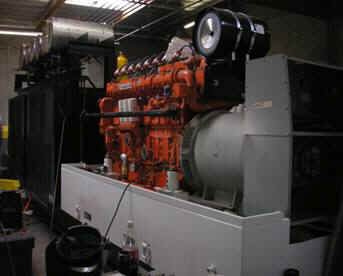
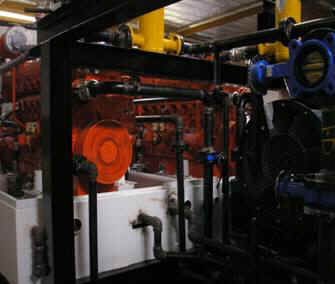
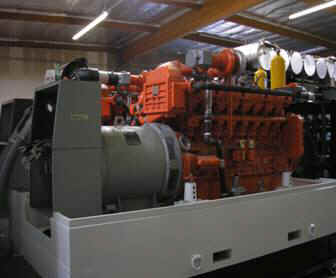
The CHP System
below is Rated at 900 kW and Features:
(2) Natural Gas Engines @ 450 kW each on one Skid with Optional
Selective Catalytic Reduction system that removes Nitrogen
Oxides to "non-detect."
The Effective Heat Rate of the CHP
System below is
4100 btu/kW with a Net System Efficiency of 92%.
CHP Systems
may be the best solution for your company's economic
and environmental sustainability as we "upgrade" natural gas to clean power with our
clean power generation solutions. Our
emissions
abatement solutions reduce nitrogen
oxides (NOx) to "non-detect" and can be installed and operated in most EPA non-attainment regions!
"Changing the Way
the World Makes and Uses Energy"
Austin, Texas
marketing@DemandSideManagement.com
Background information and history of Demand Side Management
Demand-side management (DSM) programs consist of the planning, implementing,
and monitoring activities of electric utilities that are designed to encourage
consumers to modify their level and pattern of electricity usage.
In the past, the primary objective of most DSM programs was to provide
cost-effective energy and capacity resources to help defer the need for new
sources of power, including generating facilities, power purchases, and
transmission and distribution capacity additions. However, due to changes
occurring within the industry, electric utilities are also using DSM to
enhance customer service. DSM refers only to energy and load-shape modifying
activities undertaken in response to utility-administered programs. It does
not refer to energy and load-shape changes arising from the normal operation
of the marketplace or from government-mandated energy-efficiency standards.
Historical Information of DSM (1999)
In 1999, 848 electric utilities report having demand-side management (DSM)
programs. Of these, 459 are classified as large, and 389 are classified as
small utilities. This is a decrease of 124 utilities from 1998.(1) DSM costs
were almost unchanged at 1.4 billion dollars in both 1998 and 1999.
Energy Savings for the 459 large electric utilities increased to 50.6 billion
kilowatt hours, 1.4 billion kilowatt hours more than in 1998. These energy
savings represent 1.5 percent of annual electric sales of 3,312 billion
kilowatthours(2) to ultimate consumers in 1999.
Actual peak load reductions for large utilities decreased in 1999 to 26,455
megawatts. Potential peak load reductions of 43,570 megawatts were an increase
of 2,140 over 1998.
In 1999, incremental energy savings for large utilities were 3.1 billion
kilowatt hours, incremental actual peak load reductions were 2,263 megawatts.
Technologies Used in Demand Side Management:
These energy conservation technologies are implemented to reduce total energy
use. Specific technologies include energy-efficient lighting, appliances, and
building equipment, all of which can be found on the EREN Buildings Energy
Efficiency page. For energy efficiency at industrial sites, see the EREN
Industrial Energy Efficiency page.
Load Leveling:
These technologies are used to smooth out the peaks and dips in energy demand
— by reducing consumption at peak times ("peak shaving"),
increasing it during off-peak times ("valley filling"), or shifting
the load from peak to off-peak periods — to maximize use of efficient
baseload generation and reduce the need for spinning reserves.
Load control:
Energy management control systems (EMCSs) can be used to switch electrical
equipment on or off for load leveling purposes. Some EMCSs enable direct
off-site control (by the utility) of user equipment. Typically applied to
heating, cooling, ventilation, and lighting loads, EMCSs can also be used to
invoke on-site generators, thereby reducing peak demand for grid electricity.
Energy storage devices located on the customer's side of the meter can be used
to shift the timing of energy consumption.
Issues Involving the Implementation Demand Side Management Solutions
Include: Public Benefits Programs, Rate Schedules, Time-of-Use Rates,
Power Factor Charges, and Real-Time-Pricing
Public Benefits Programs
Prior to electricity industry restructuring, utilities were responsible for a
variety of programs (including DSM) that meet social objectives. Under
restructuring, funding for these programs is typically through a small
surcharge ("wires charge" or "system benefits charge") on
utility bills.
Rate Schedules
Utilities can structure their rates to encourage customers to modify their
pattern of energy use.
Time-of-Use Rates
Time-of-use
rates involve charging higher prices for peak electricity as a way to shift
demand to off-peak periods. Interruptible rates offer discounts in exchange
for a user commitment to reduce demand when requested by the utility.
Power Factor Charges
Power
factor charges can be implemented to discourage commercial and industrial
utility customers from partially loading their electrical equipment, as this
requires the utility to generate extra current to cover the resulting system
losses.
Real-Time Pricing
Real-time
pricing is where the electricity price varies continuously (or hour by hour)
based on the utility's load and the different types of power plants that have
to be operated to satisfy that demand.
What is
Automated Demand
Response?
Automated
Demand Response is a Demand Side Management solution that is
specifically designed for a customer's specific location, energy/power
requirements, and also for the specific electric rates for that customer's
location. Automated Demand Response does not involve human intervention, but is initiated at a facility through receipt of an external communications signal.
Automated Demand Response is a rather new area of DSM technologies and may
provide a lucrative revenue stream for customers who can curtail electric load in response to demand incentives, ICAP payments, and/or commodity prices.
Automated demand response technology seeks to automatically, through
software and hardware applications, to respond to variations in the
electricity/power market prices.
Demand Response or Demand Side Management can be achieved through demand reduction, by shifting load to a less expensive time period, or by substituting another resource for delivered electricity (such as
natural gas or onsite power generation, also known as "distributed
generation."
Demand Response (DR) is a set of activities to reduce or shift electricity use to improve electric grid reliability, manage electricity costs, and ensure that customers receive signals that encourage load reduction during times when the electric grid is near its capacity. The two main drivers for widespread demand responsiveness are the prevention of future electricity crises and the reduction of electricity prices. Additional goals for price responsiveness include equity through cost of service pricing, and customer control of electricity usage and bills. The technology developed and evaluated in this report could be used to support numerous forms of DR programs and tariffs.
A recent pilot test to enable an Automatic Demand Response system in California has revealed several lessons that are important to consider for a wider application of a regional or statewide Demand Response Program.
The six facilities involved in the site testing were from diverse areas of our economy. The test subjects included a major retail food marketer and one of their retail grocery stores, financial services buildings for a major bank, a postal services facility, a federal government office building, a state university site, and ancillary buildings to a pharmaceutical research company. Although these organizations are all serving diverse purposes and customers, they share some underlying common characteristics that make their simultaneous study worthwhile from a market transformation perspective. These are large organizations. Energy efficiency is neither their core business nor are the
decision-makers who will enable this technology powerful players in their organizations. The management of buildings is perceived to be a small issue for top management and unless something goes wrong, little attention is paid to the building manager's problems.
All of these organizations contract out a major part of their technical building operating systems. Control systems and energy management systems are proprietary. Their systems do not easily interact with one another. Management is, with the exception of one site, not electronically or computer literate enough to understand the full dimensions of the technology they have purchased. Despite the research teams development of a simple, straightforward method of informing them about the features of the demand response program, they had significant difficulty enabling their systems to meet the needs of the research. The research team had to step in and work directly with their vendors and contractors at all but one location. All of the participants have volunteered to participate in the study for altruistic reasons, that is, to help find solutions to California's energy problems. They have provided support in workmen, access to sites and vendors, and money to participate. Their efforts have revealed organizational and technical system barriers to the implementation of a wide scale
program.
What is Demand
Response and How is it Different from "Demand Side
Management"?
"Demand
Response" is a subset of Demand Side
Management (DSM) or a potential Demand Side Management program
solution which helps make the electric grid much more efficient and balanced
by assisting the electric grid's commercial and industrial customers reduce
their electric demand, and/or shifts the time period when they use their
electricity, and/or prioritizes the way they use electricity, and in so doing,
reduces their overall energy costs. A Demand Side Management Program will
include measures that promotes the following:
-
Reduced
customer peak and overall energy demand
-
Improves the electric grid's reliability
-
Balances
the electric grid through increased efficiency
-
Energy
efficiency
-
Manages electricity costs
-
Conservation
through both behavioral and operational changes
-
Load
management
-
Fuel
switching
-
Distributed
energy
-
And provide systems that encourage load shifting or load shedding
during times when the electric grid is near its capacity or electric
power prices are high
Demand
Response has also been defined as a "Demand Side Management"
subset that is a set of time dependent activities that reduces or
shifts electricity use of selected customers.
Electric power generation and distribution systems are strongly affected by supply-side policies (how, when, and where to generate electricity, how to couple generation into the grid, how to transmit and distribute generated electricity) and demand-side policies (pricing schemes, conservation efforts, customer premises automation, and, in extreme circumstances, rolling blackouts).
Demand-side programs focus on reducing the peak-to-average demand profiles through automation in the customer premises.
What
are Demand Response
Programs?
Demand
Response Programs
are programs usually designed and offered by
electric utilities that offers those clients that sign-up for specific DR
programs with financial incentives and other benefits that help those
participating customers to curtail energy use. These actions by the
electric utilities and participating clients provide a reliable,
predictable amount of power (megawatts) that the ISO's and RTO's can count on during an emergency when energy supplies are
low, and there is an inadequate amount of available power generation. The
electric utilities typically require that those customers that enroll in
their DR program(s) install certain software and hardware, that communicates
with these client's online energy management systems, and can control
these client's electric power requirements as needed.
What is Battery
Energy Storage?
Battery
Energy Storage, and Battery
Energy Storage systems (BESS)
use stored electrical power in batteries, and feed this energy to the electric
grid (building, or facility) at times when it makes economic sense.
For
a "Net
Zero Energy" building or facility, a Solar
Cogeneration, or Solar
Trigeneration energy system is
used that stores excess solar power in the Battery
Energy Storage system during
the daytime, for use when the sun goes down, and during inclement weather.
Battery
Energy Storage is an ideal solution for utility-scale
wind farms, particularly in Texas, when most of the renewable energy is
generated at night when the power isn't needed.
Battery
Energy Storage is a
leading "dispatchable
wind" solution making wind power
available 24 x 7.
And,
Battery
Energy Storage is
an ideal demand
side management, peak
shifting or load
leveling solution as well as reducing emissions
According
to Sandia Labs in their report titled; "Energy
Storage for the Electricity Grid; Benefits and Market Potential Assessment Guide"
(February 2010), the market for energy storage exceeds $100 billion during the
next ten years.
What
is Bulk Energy
Storage?
Bulk
energy storage refers to various methods to
"store" electricity within an electrical power grid.
Electrical
energy can be stored during times that electrical generation from power plants
exceeds the consumption by customers and the stored energy can then be utilized
at times when consumption of electricity exceeds generation of electricity. Bulk
energy storage permits power generation to be maintained at a more
constant level, avoiding the sharp spikes in power generation so that the power
plants can be more efficiently operated - reducing fuel consumption thereby
reducing greenhouse
gas emissions.
According
to Sandia Labs in their report titled; "Energy
Storage for the Electricity Grid; Benefits and Market Potential Assessment Guide"
(February 2010), the market for energy storage exceeds $100 billion during the
next ten years.
What
are CHP Systems?
A
CHP System -
also known as a cogeneration
plant, is the simultaneous production of power and thermal energy.
Stated
another way, a CHP
System integrates an onsite, "decentralized
energy" (DE) or "dispersed
generation" power and energy system with thermally-activated
power and energy technologies such waste
heat recovery and/or absorption
chillers for heating and/or cooling applications.
CHP
Systems achieve these greater energy efficiencies
through the conversion of exhaust or reject heat from power generation into
needed energy services like cooling and heating of buildings as well as
campuses. This is called "Waste
Heat Recovery" or "Recycled
Energy." Development of "packaged" or
"modularized" CHP
Systems for end-use applications, such as commercial and
institutional buildings, is something the founder of our company has been
involved with since the mid 1980's.
In the past, Cogeneration
plants have been economically attractive only in sizes above several megawatts.
The emergence of a number of small generation technologies, including fuel
cells, advanced low emissions engines, and gas turbines
with outputs in the 1000 kW - 5000 kW range, should extend the benefits of Integrated
Energy Systems to a much larger user base, with a consequent increase in
national energy and environmental benefits.
For
example, the application of CHP
Systems (including Absorption
Chillers - or - ADsorption
Chillers) in commercial buildings could reduce commercial building
energy consumption by 30%.
Application
of such smaller-scale packaged CHP
Systems provides a major breakthrough in energy efficiency
technology, energy savings as well as reduced greenhouse
gas emissions. And, by locating the power generation at or near the
end-user/consumer, i.e. their facility, building, or campus, the difficulties in
siting and building new electric transmission and electric distribution
infrastructures to meet today's increasing power demand are minimized.
There are numerous markets for Cogeneration
/ Trigeneration
plants, CHP Systems,
District
Energy Systems for commercial or institutional buildings, government
facilities, and district energy systems that distribute thermal energy to
buildings in a college campus, hospital complex, industrial park, food
processing operations, refrigerated warehouses, and also very attractive for
cities.
What is "Decentralized Energy"?
Decentralized
Energy
is the opposite of "centralized energy."
Decentralized
Energy
energy generates the power and energy that a residential, commercial or
industrial customer needs, onsite. Examples of decentralized energy production
are natural gas fueled CHP
Systems, Rooftop
PV and solar
cogeneration energy systems.
Today's
electric utility industry was "born" in the 1930's, when fossil fuel
prices were cheap, and the cost of wheeling the electricity via transmission
power lines, was also cheap. "Central" power plants could be
located hundreds of miles from the load centers, or cities, where the
electricity was needed. These extreme inefficiencies and cheap fossil fuel
prices have added a considerable economic and environmental burden to the
consumers and the planet.
Centralized
energy is found in the form of electric utility companies that generate power
from "central" power plants. Central power plants are highly
inefficient, averaging only 33% net system efficiency. This means that the
power coming to your home or business - including the line losses and
transmission inefficiencies of moving the power - has lost 75% to as much as 80%
energy it started with at the "central" power plant. These
losses and inefficiencies translate into significantly increased energy expenses
by the residential and commercial consumers.
Decentralized
Energy is the Best Way to Generate
Clean and Green Energy!
How
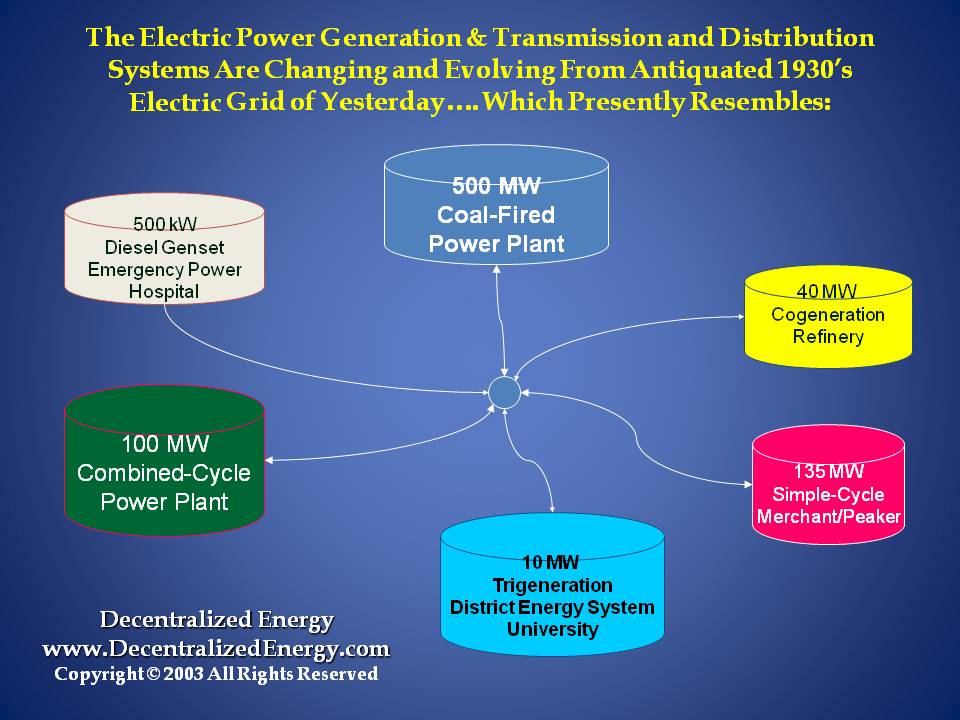
we make and distribute electricity is changing!
The
electric power generation, transmission and distribution system (the electric
"grid") is changing and evolving from the electric grid of the 19th
and 20th centuries, which was inefficient, highly-polluting, very expensive and
“dumb.”
The
"old" way of generating and distributing energy resembles this slide:
Some
customers will choose to dis-connect from the grid entirely.
(Electric grid represented by the small light blue circles in the slide below.)
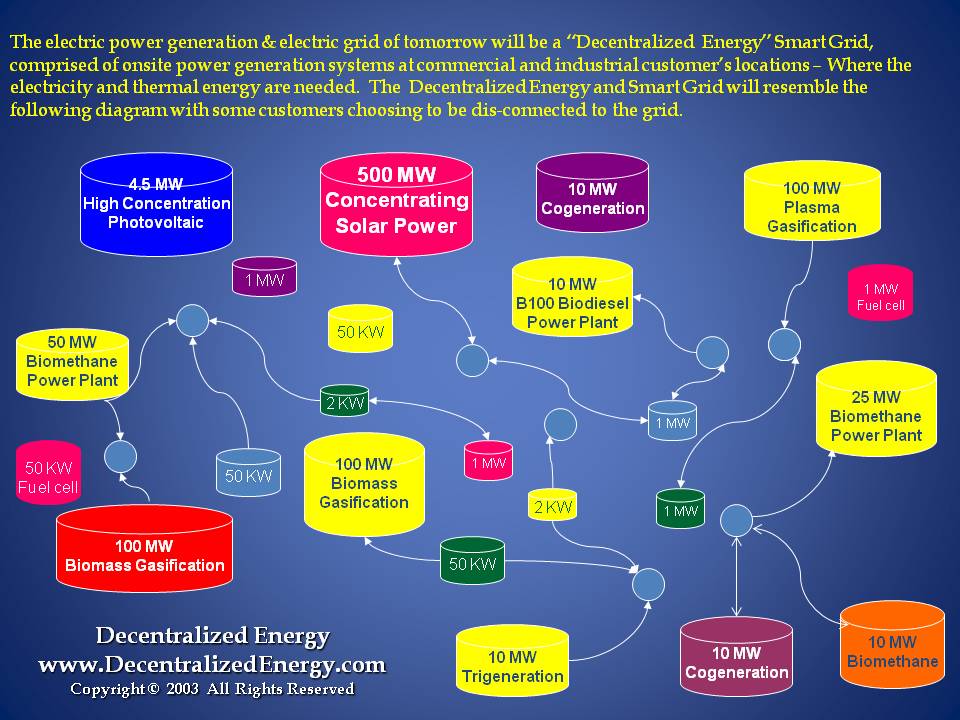
Typical
"central" power plants and the electric utility companies that own
them will either be shut-down, closed or go out of business due to one or more
of the following: failed business model, inordinate expenses related to central
power plants that are inefficient, excessive pollution/emissions, high costs,
continued reliance on the use of fossil fuels to generate energy, and the
failure to provide efficient, carbon
free energy and pollution
free power.
Carbon
free energy
and pollution
free power
reduces our dependence on foreign oil and makes us Energy Independent while
reducing and eliminating Greenhouse
Gas Emissions.
What is Flywheel Energy Storage?
A
Flywheel
Energy Storage system is supposed
to act as mechanical batteries that store power kinetically in the form of a rotating
mass, or "flywheel."
When
the grid goes down, the power stored by the rotating flywheel is converted to electrical energy through the flywheel’s integrated electric generator. The system provides the DC energy to the
Uninterruptible
Power Supplies or "UPS" system until
grid power is restored or the facility's back-up power generator can be started. Once either the utility is restored or the genset provides power to the input of the
UPS system, the Flywheel
Energy Storage system will be re-charged by taking some current from the DC bus of the
Flywheel
Energy Storage until it is back up to full
speed.
Problems of Flywheel Energy Storage
Mechanical
- moving parts translate into high maintenance and operations as well as
break-downs.
Operate
at high speeds - some flywheel energy storage systems spin at 24,000
RPMs and higher.
"Wobble"
effect - the flywheel spins at high-speed and its' inertia tends to make
it wobble and exerts enormous force on the bearings as the flywheel works
against the "natural axis" of the flywheel. To counter this, most
flywheel energy storage companies use expensive
bearings and magnets as well as expensive materials (high-grade carbon fiber
&/or high-grade steel) to counter the wobble and spinning forces on
the flywheel.
Short run-down
time - TFrom the time that a flywheel energy storage system has been
"wound-up" and ready for use, to the time it can actually be used in
means that they are not able to be used for long-term applications. Most
flywheel energy storage systems are therefore limited to short term applications
ranging anywhere for a few minutes up to an
hour. This means that the actual run-time periods while deploying flywheel
energy storage systems are very expensive, i.e. $300,000 to $3 million / MWh (megawatt hour).
Expensive
to buy, own and operate - The high costs of flywheel energy storage
upwards - from $300,000 to $3 million / MWh (megawatt hour) for the best
flywheel energy storage systems are not competitive with other energy storage
and frequency regulation alternatives, particularly when the operating and
maintenance costs are factored in. The biggest and best of all flywheel energy
storage companies, Beacon Power, filed for bankruptcy in 2011.
Solutions and Alternatives to Flywheel Energy Storage
There
are a number of alternatives for companies considering Flywheel
Energy Storage systems for UPS, Frequency Regulation,
Demand Side Management and Clean Power Generation. In terms of cost and
run-time, CHP systems,
operating in either cogeneration
or trigeneration
mode, are nearly impossible to compete with.
CHP Systems
are inxpensive
to buy, own and operate:
CHP
systems cost +/- $2 million / MW to buy. With natural gas at $3.00 / mmbtu,
CHP systems,
operating in either cogeneration
or trigeneration
mode have a fuel cost of +/- $0.03 (3 cents) / kWh and can run practically 24 x
7 x 365.
We
can package a CHP
system, operating in either cogeneration
or trigeneration
and have it installed, commissioned and running in
about 2 months. Call / e-mail us for more information or a price quote. See
pictures below of a 900 kW CHP
system that was
custom-built for one of our clients.
What is Peak
Shifting?
Peak
Shifting is a
highly cost-effective method of reducing electric utility expenses. When
electric utility commercial or industrial customers use electricity can make a
big difference on their monthly electric bills. By shifting the time of day that
electric power is used, a commercial or industrial customer can reduce their
" demand charge" portion of their electric bill during peak times of
the day. This reduces the overall cost of power each month for the customer.
Unlike
most products, electricity can’t be stored after it's generated. Electricity
must be generated - and consumed - at the time of demand by a utility's
customer. Electricity usage continuously varies throughout the day, and varies
from month-to-month and season-to-season. Each day, there are "peak"
demand periods of usage during which time the electric utilities must generate
additional amounts of electricity to meet these peak demands for all of their
customers.
To meet this additional peak demand for electricity utilities use “peaking
generators” also called "peaking plants" or simply "peakers."
These peaking plants are the least efficient methods of generating power,
meaning they generate less power with more fuel (and their associated greenhouse
gas emissions) compared with the utility's base-load generators. These peaking
plants typically burn oil or natural gas to produce the electricity and are
brought on line only during "peak periods" of the day and run for
short periods.
While
peaking generators generally cost less to build than other types of generators,
they also have relatively high fuel costs because they are typically much less
efficient in the use of fuel.
Therefore, "Peak
Shifting" is a method that addresses
shifts the time of day when electricity is used, reducing the need for peaking
plants and can reduce a commercial or industrial customer's electric bills, if
correctly implemented.
What
is "Trigeneration"?
Trigeneration
is the simultaneous production of three forms of energy - typically, Cooling,
Heating and Power - from only one fuel input. Put another way, our trigeneration
power plants produce three
different types of energy for the price of one.
Trigeneration
energy
systems can reach overall system efficiencies of 86% to
93%. Typical "central" power plants, that do not need the heat
generated from the combustion and power generation process, are only about 33%
efficient.
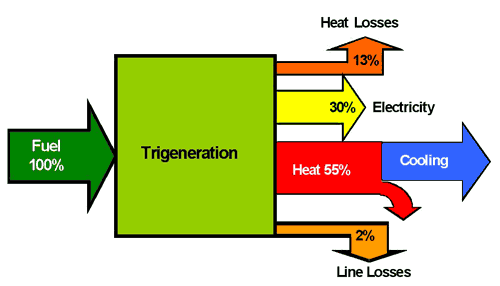
Trigeneration
Diagram & Description
Trigeneration Power Plants' Have the Highest System Efficiencies and are
About 300 % More Efficient than Typical Central Power Plants
Trigeneration
plants are installed at locations that can benefit from all three forms of
energy. These types of installations that install trigeneration
energy systems are called "onsite power generation" also referred to as
"decentralized energy."
One
of our company's principal's first experience with the design and development of
a trigeneration power plant was the trigeneration
power plant installation at Rice University in 1987 where
our trigeneration
development team started out by conducting a
"cogeneration" feasibility study.
The EPC
contractor that Rice University selected installed the trigeneration
power which included a 4.0 MW
Ruston gas turbine power plant, along with waste heat recovery
boilers and Absorption Chillers.
A "waste heat recovery
boiler" captures the heat from the exhaust of the gas turbine. From
there, the recovered energy was converted to chilled water - originally from (3)
Hitachi Absorption Chillers - 2 were rated at 1,000 tons each, and the third
Hitachi Absorption Chiller was rated at 1,500 tons. The Hitachi Absorption Chillers
were replaced shortly after their installation by the EPC
company. The first trigeneration
plant at Rice University was so successful, they added a second 5.0 MW trigeneration
plant so today, Rice University is now generating about 9.0 MW of
electricity, and also producing the cooling and heating the university needs
from the trigeneration
plant and circulating the trigeneration
energy around its
campus.
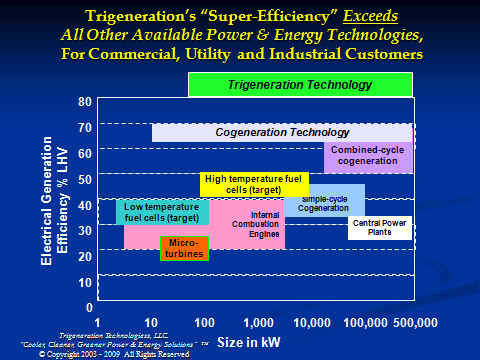
Trigeneration Chart
Trigeneration's
"Super-Efficiency" compared
with other competing technologies
As you can see, there is No Competition for Trigeneration!
Trigeneration power plants are the ideal onsite power
and energy solution for customers that include: Data
Centers, Hospitals, Universities, Airports, Central Plants, Colleges
& Universities, Dairies, Server Farms, District Heating & Cooling
Plants,
Food Processing Plants, Golf/Country
Clubs, Government Buildings, Grocery Stores, Hotels, Manufacturing
Plants,
Nursing Homes, Office
Buildings / Campuses,
Radio Stations, Refrigerated
Warehouses,
Resorts,
Restaurants,
Schools, Server Farms, Shopping Centers, Supermarkets, Television
Stations, Theatres and Military Bases.
At
about 86% to 93% net system efficiency, our trigeneration
power plants are about 300% more efficient at providing energy than your current
electric utility. That's because the typical electric utility's power plants are
only about 33% efficient - they waste 2/3 of the fuel in generating electricity
in the enormous amount of waste heat energy that they exhaust through their
smokestacks.
Trigeneration
is defined as the simultaneous production of three energies: Cooling,
Heating and Power.
Our trigeneration
energy systems use the same amount of fuel
in producing three energies that
would normally only produce just one type of energy. This means our customers
that have our trigeneration
power plants have significantly
lower energy expenses, and a lower carbon footprint.
Press Release
Feb 14, 2012
Washington, D.C.
by the Renewable Energy Institute
HR 4017, the Smart Energy Act, was introduced in the U.S. House of
Representatives by Representatives Charles Bass (R-NH) and Jim Matheson
(D-UT). The Smart Energy Act seeks to establish financing mechanisms for energy efficiency retrofits for buildings and
also to set a national goal to double the
amount of power generated by CHP
Systems which includes cogeneration
and trigeneration
systems, to 170 Gigawatts by 2020.
"Net Zero Energy"
to Become $1.3 Trillion/year Industry by 2035
"Changing the Way
the World Makes and Uses Energy"
Austin, Texas
marketing@
DemandSideManagement .com
Net Zero Energy
Market to Become $1.3 Trillion/year Industry by 2035
Net Zero Energy Buildings Are Coming - What About The Buildings Already Standing?
http://www.forbes.com/sites/justingerdes/2012/02/28/net-zero-energy-buildings-are-coming-what-about-the-buildings-already-standing/
Products,
Services and Additional Information
Absorption
Chillers
* Architecture
* Battery
Energy Storage * Buildings
of the Future
CHP
Systems * Clean
Power Generation * Cogeneration
* Clean
Power Generation
Compressed
Air Energy Storage *
Distributed
PV * EcoGeneration
* Emissions
Abatement
Energy
Master Planning *
Evacuated
Tube Collectors * Flat
Plate Collectors * Flywheel
Energy Storage
Mechanical
Electrical Plumbing
* Micro-Grid
* Net
Zero Energy * Net Zero Energy Building
Retrofits
Pumped
Hydro Storage *
Renewable
Energy Technologies * Rooftop
PV * Solar
Cogeneration
Solar
Thermal Systems * Solar
Trigeneration * Rooftop
PV * Trigeneration
* Waste
Heat Recovery
About
us:
The
founder of the Renewable Energy Institute (REI) was first involved in Net Zero
Energy buildings and Solar
Trigeneration sm
energy system in 2001
- 2002. This started with family-owned real estate developments in
Northern and Southern California. This interest was accelerated when REI's
founder was introduced to the President of a solar company in Los Angeles and
their client, the Audubon Nature Center at Deb's Park (Los Angeles) that was
planning to build a new 5,000 sf office and conference center. Except, the new
building for the Audubon Nature Center was about 1/2 mile from the end of the
power lines and a very costly extension of the power lines to their new facility
forced them to consider a solar solution. When the Audubon Nature Center's new
5,000 sf office and conference center was completed in 2003, the facility not
only featured the Solar
Trigeneration sm energy
system - they were awarded one of the first Platinum LEED Awards by the USGBC -
and the powerlines were still 1/2 mile away! To this day, 100% of the power and
energy for the Audubon Nature Center's building is supplied by the Solar
Trigeneration sm
energy system - whether at 12 noon, or 12 midnite. (The Audubon's facility
also includes a battery
energy storage
system for back-up power generated by the Rooftop
PV
panels as well as a thermal energy storage system that stores the excess hot
water generated by the evacuated
tube collectors).
These early projects led to more client inquiries and engagements with real
estate developers, architects and building owners in Southern California,
Louisiana and Texas and the advent of a growing Net Zero
Energy industry along with Solar
Cogeneration sm
& Solar
Trigeneration sm
energy systems. This culminated in a family-owned 200
(Net Zero
Energy) home real estate development
in Desert Hot Springs which has been approved but not yet constructed.
During this time, the REI's Founder
became a volunteer and Advisor
to the University of Texas' Solar Decathlon Competition. He coordinated the
donation of the same solar
thermal system used at the Audubon Nature Center's facility in Los Angeles, for UT's entry in
the 2002 Solar Decathlon Competition in Washington, D.C. UT's entry in the
Solar Decathlon Competition placed 1st in the domestic hot water
competition
that year (2002) and 4th overall, out of 20 universities that had entered.
In
2006, after Hurricane Kattrina devastated New Orleans, the REI was
formed and several of the
REI's board members and a Professor from the University of Texas School of
Architecture formed a design team to enter the Brad Pitt/Global Green Rebuild New Orleans Competition.
Our entry also focused on sustainable building solutions and materials as well
as the Net Zero
Energy concepts, incorporating once again, a Solar
Trigeneration sm
energy system.
Today,
the REI "Flagship" has chartered the Renewable Energy Institute in
Florida, with discussions to open REI state chapters in Arizona, California,
Hawaii, Minnesota and Oregon.
The
REI supports greater use of Net Zero Energy systems by architects, builders, homeowners and
owners of commercial buildings. This includes "upgrading" homes and
commercial buildings to Net Zero Energy. The REI provides Net Zero Energy;
advertising, business development, conferences, e-commerce, education, marketing, online
marketing, public relations, renewable energy, sales and strategic marketing solutions for
architects, builders, cities, colleges, HVAC contractors, Net Zero Energy developers, real
estate developers and universities.
Net
Zero Energy Buildings Are Next Frontier
http://www.sustainablebusiness.com/index.cfm/go/news.display/id/23361
Net
Zero Energy Market to Become $1.3 Trillion/year Industry by 2035
http://www.navigantresearch.com/newsroom/revenue-from-net-zero-energy-buildings-to-reach-1-3-trillion-by-2035
Net Zero Energy Buildings Are Coming - What About The Buildings Already
Standing?
http://www.forbes.com/sites/justingerdes/2012/02/28/net-zero-energy-buildings-are-coming-what-about-the-buildings-already-standing/
American
Energy Plan sm
www.AmericanEnergyPlan.org
3-5
million new jobs
Fuel Savings of > $1.50/gallon
American Energy Independence
Ends the worst economic depression of all time

NO
FOREIGN OIL!
www.NoForeignOil.com
Support
Renewable Energy
and America's
Renewable Energy Technologies
resources and companies!
“spending
hundreds and hundreds and hundreds of billions of dollars every year for oil,
much of it from the Middle East, is just about the single stupidest thing that
modern society could possibly do. It’s very difficult to think of anything
more idiotic than that.”
~ R. James Woolsey, Jr., former
Director of the CIA
According to R. James Woolsey, for Director of the Central Intelligence Agency, “The basic insight is to realize that global warming, the geopolitics of oil, and warfare in the Persian Gulf are not separate problems — they are aspects of a single problem, the West’s dependence on oil."
We support the Renewable Energy Institute by donating a portion of our profits to the
Renewable Energy Institute
in their efforts to reduce fossil fuel use by transitioning to Renewable
Energy Technologies and reducing/eliminating Carbon
Emissions, Carbon
Dioxide Emissions and Greenhouse
Gas Emissions.
The Renewable Energy Institute
is "Changing The Way The World Makes and Uses Energy" SM
by providing research & development, funding and resources that reduce the
cost of Renewable
Energy Technologies and
making a faster transition to Carbon Free
Energy, Clean
Power Generation, & Pollution Free
Power."
Follow
us on Twitter:
#DemandSideManagement #DSM #DemandResponse


"Changing the Way the World Makes and Uses Energy" sm
Demand Side Management
www.DemandSideManagement.com
Austin, Texas
marketing@DemandSideManagement.com
DemandSideManagement.com
Copyright © 2004
All Rights Reserved